 MoldHelpUSA
Why mold is common in San Antonio
San Antonio International Airport averages about 32 inches of rain a year under NOAA's 1991–2020 normals, but the yearly total hides how the rain arrives. May, September, and October are the wettest months, and much of the water comes in short, intense storms. The city's wettest day on record brought 11.26 inches on October 17, 1998, and that October remains the wettest month on record at 18.07 inches. September 2018 came close with 16.86 inches.
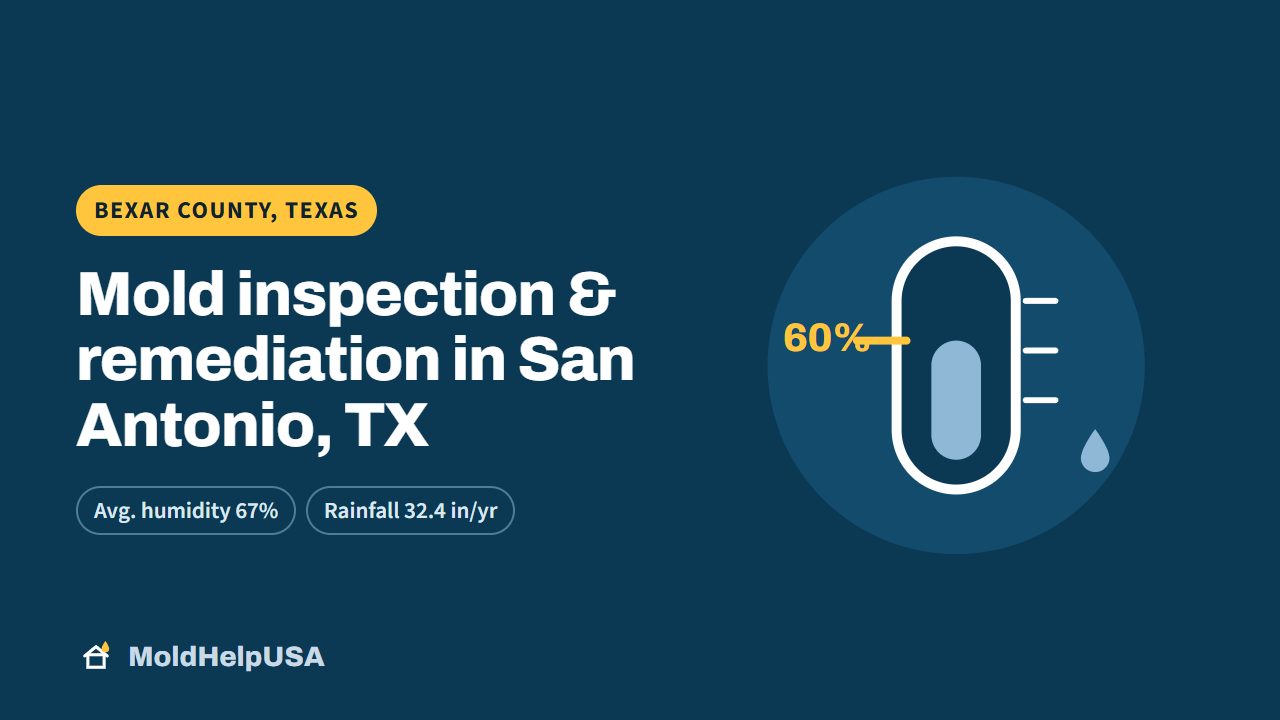
Humidity slows the drying. Average relative humidity is about 67%, and on a typical morning it reaches the low 80s. After a storm, a soaked attic, wall cavity, or crawl space can stay damp for days, and the EPA warns that mold growth becomes likely if wet materials are not dried within 24 to 48 hours.
The housing stock creates two different problems. Older neighborhoods near downtown, such as Monte Vista, Tobin Hill, and King William, include many pier-and-beam houses with crawl spaces, where a plumbing leak or poor ventilation can go unnoticed for months. Newer subdivisions on the north and west sides mostly sit on concrete slabs, where a slab leak or a failed water heater usually shows up first as damp flooring or dark baseboards. Freezes add a third risk: the February 2021 winter storm burst pipes in homes across Texas.
Source: NOAA climate normals
Mold services in San Antonio
What mold work costs in Bexar County
| Service | Typical range |
|---|---|
| Mold inspection, San Antonio area | $200–$600 |
| Post-remediation clearance test | $150–$400 |
| Remediation, priced per square foot | $9–$43 per sq ft |
| Typical residential remediation (national data) | $1,150–$3,400 |
| Extensive or whole-house growth | Up to about $20,000 |
San Antonio contractor guides published in 2026 supply the inspection and clearance figures, and a 2026 San Antonio estimate supplies the wide $9 to $43 per square foot range; the typical and extensive job figures are national homeowner data. The spread reflects how different jobs are, from a bathroom ceiling to a full crawl space. Ask the assessor for a written protocol with square footage, then compare remediation bids against that same scope. More on pricing in our mold remediation cost guide.
Texas mold licensing: what to check
Two licensed companies, not one, usually handle a sizable mold job in San Antonio. The Texas Department of Licensing and Regulation (TDLR) licenses mold assessment consultants, who inspect and write the protocol, and mold remediation contractors, who do the removal, and state law bars a license holder from filling both roles on the same project. Look up each company at tdlr.texas.gov before signing anything.
A license is mandatory for removal once growth covers 25 contiguous square feet or more, a size that is easy to reach in a King William or Tobin Hill crawl space. Under SB 1255, effective September 1, 2025, employees doing the hands-on assessment or remediation must also be licensed or registered with TDLR. Owners of a residential property with fewer than 10 dwelling units can handle their own home without a license. Paperwork to expect: the Consumer Mold Information Sheet before work, a passed clearance report afterward, and a Certificate of Mold Damage Remediation within 10 days. If you sell later, you must give the buyer any certificates issued in the past five years.
Will insurance cover it?
San Antonio mold claims usually begin with one of three events: a storm that tears up a roof, a flash flood that comes through a door, or a plumbing failure inside the house. Each lands differently. Rising water from a flash flood needs a flood policy; a standard homeowners policy excludes it, and a new National Flood Insurance Program policy usually waits 30 days before it takes effect, according to FEMA.
Wind or hail damage that lets rain in is normally handled with the roof claim, so report the roof and the soaked ceiling together. The Texas Department of Insurance says most policies cover sudden and accidental water damage, such as a broken washer hose, and mold on items damaged that way, but not long-running leaks; many Texas policies also cap or exclude mold remediation. Hold on to your Certificate of Mold Damage Remediation, since an insurer may not use corrected mold damage against you in underwriting. Our guide to insurance and mold covers the details.
Areas we connect you in
Alamo Heights, Terrell Hills, Monte Vista, Tobin Hill, King William, Southtown, Castle Hills, Windcrest, Medical Center, Leon Valley, Stone Oak, Alamo Ranch, and surrounding neighborhoods of San Antonio.